Portfolio Management Excellence Online assessment & benchmark
Free online assessment · anonymised

How mature is your portfolio management – really?

Rate how your organisation actually decides what to invest in, in which order, and when to stop. You get your maturity level, your profile on the six categories of the Portfolio Excellence Framework, your position against other companies and industries, and the good practices that would move you forward.

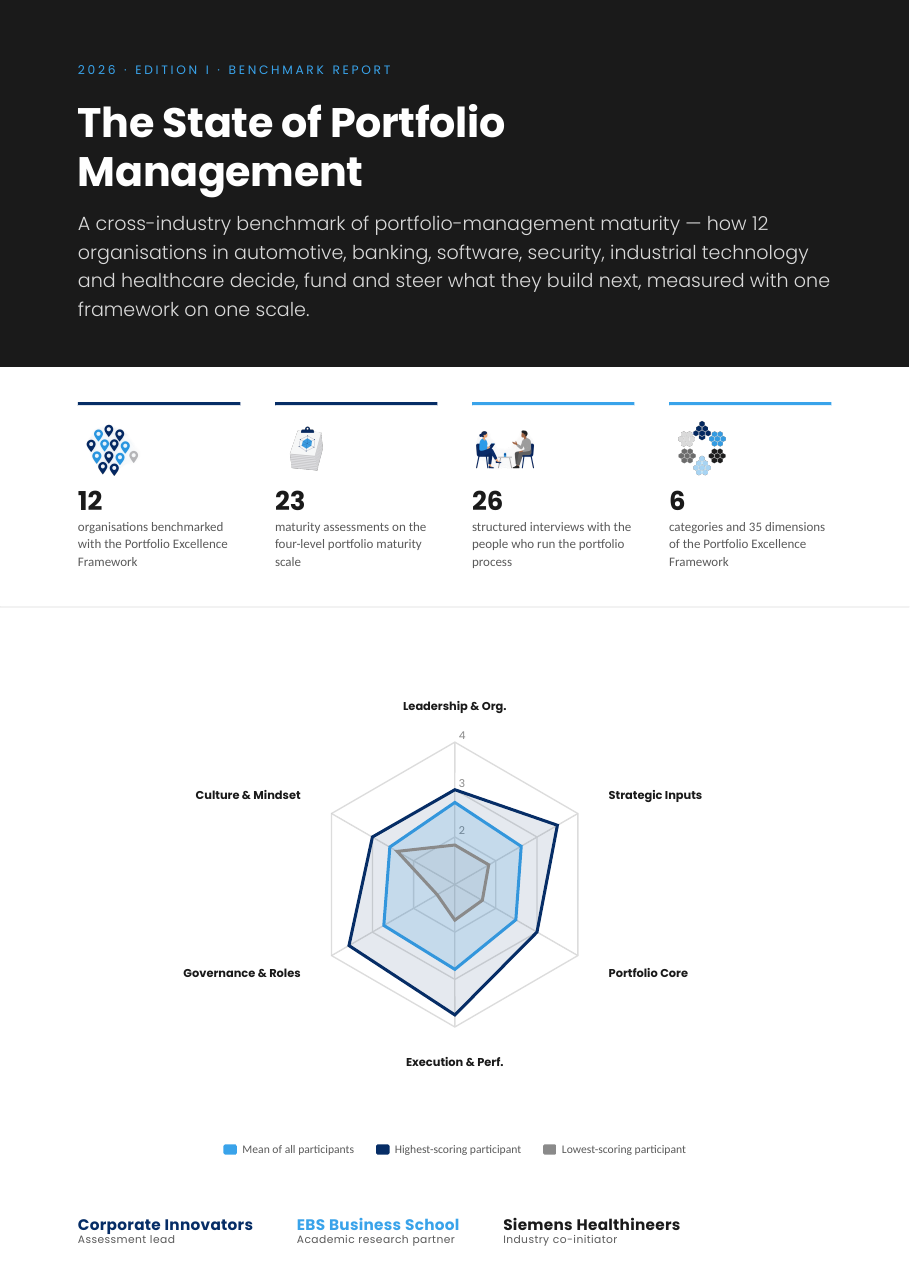
234Leadership & Org.Strategic InputsPortfolio CoreExecution & Perf.Governance & RolesCulture & Mindset
Mean of all participantsHighest-scoring participantLowest-scoring participant
The 2026 cross-industry benchmark: twelve organisations on the six categories of the framework, scored 1–4
Built on evidence

The 2026 Cross-Industry Portfolio Management Benchmark

How organisations in automotive, banking, software, security, industrial technology and healthcare decide, fund and steer what they build next – measured with one framework on one scale. Your assessment is compared against this field.

12
organisations benchmarked with the Portfolio Excellence Framework
23
maturity assessments on the four-level portfolio maturity scale
26
structured interviews with the people who run the portfolio process
6 · 35
categories and dimensions of the Portfolio Excellence Framework
Sound familiar?

Most organisations have a portfolio process on paper. Few live it.

These are the symptoms we hear in almost every organisation we work with – and the 2026 benchmark found them across industries. Each of them has a root cause the assessment makes visible.

Everything is “priority one”

With no shared criteria and no explicit decision rights, the loudest voice or the biggest business unit wins – and the teams juggle ten top priorities at once.

From the benchmark: “Board and CTO topics go through quickly – side channels to the developers do the rest.”

The strategy is defined – but never lands in the portfolio

Strategy stays a slide: no allocation targets, no boundaries, no link between the strategic plays and the initiatives that actually get funded. Every request is equally “strategic”, and the portfolio drifts away from the intent it was meant to serve.

From the benchmark: “Strategy is aligned, but never translated into budgets.”

Requests disappear into a black box

Requesters submit and wait for months without a yes, a no or a when. The rational reaction: side channels, escalations and shadow backlogs.

From the benchmark: “I’m basically paying for you, and I don’t know when I’ll get what.”

Too much started, nothing finished

Without work-in-progress limits, capacity checks and the courage to stop, initiatives linger for years and development teams turn into maintenance teams.

From the benchmark: not one interviewee could name a project that was deliberately stopped.

What portfolio management is

The discipline of choosing – and of stopping

Portfolio management is how an organisation decides which products, services, platforms and projects to invest in, how much, in which order – and when to stop. It sits between strategy and execution: strategy says where to play, delivery says how to build. Portfolio management turns limited capacity into the set of bets that creates the most value.

Done well, it is the difference between a busy organisation and a valuable one. Done badly, it is invisible – until the symptoms above appear.

1
Translate strategy into boundariesWhere to play, how much to invest in run, grow and transform – and what is out of scope.
2
Collect and qualify opportunitiesCustomer problems, market and technology signals, internal ideas – with the evidence that makes them comparable.
3
Evaluate, prioritise and commit progressivelyValue, risk, cost of delay and capacity reality – decided in stages, not all at once.
4
Deliver and roll outDecisions reach the teams as ready, prioritised work; progress is transparent end to end.
5
Track value, rebalance, phase outRealised value against the business case, portfolio vitality, and the pruning that frees capacity for the next round.

↻ … which feeds the next strategy cycle

Maturity levels

Four levels of portfolio management maturity – where do you stand?

Every dimension, category and organisation is scored on the same four levels. The levels describe how an approach is lived, not how elaborate it is – a simple rule that everybody follows scores higher than a sophisticated process that is bypassed. In the 2026 benchmark the whole field sits inside ML-2 and the lower half of ML-3. Click a step to see what each level looks like.

ML-2 · Emerging

An approach exists but is inconsistent or often bypassed

What it looks like:

  • A gate works and a ranking exists, but escalations and side lists bypass it.
  • Status is painted; reviews are agenda items without consequence.
  • Processes, tools and committees exist – decisions are still taken outside them.

To reach Established: adoption – rules that bind the people who set them, hand-overs with owners, every requester gets an answer. Not more process: the existing one has to be lived.

Where most of the 2026 benchmark sits – mean 2.68 of 4.Equivalent: ITIL 2 · P3M3 2 · CMMI 2

The four levels follow the maturity logic of P3M3 and CMMI – from an initial, repeatable and defined approach to one that is measured and continually improved – applied to the portfolio-management process of ISO 21504 and cross-walked to the ITIL 4 capability levels.

The Portfolio Excellence Framework

Six categories, 35 dimensions

The framework describes what excellent portfolio management looks like in practice: leadership as the roof, strategic inputs feeding the portfolio core that drives execution, and governance and culture as the foundation. Click a part of the house to see what it covers.

The framework builds on ISO 21504, P3M3 and Lean Portfolio Management, and on years of portfolio work in large R&D and service organisations.

The engine · 8 dimensions

Portfolio management core

The decision process itself: how the portfolio is structured, how customer value is defined, how opportunities enter, are evaluated, prioritised and committed in stages, how capacity and work in progress are managed – and how the portfolio as a whole is assessed, rebalanced and pruned.

What excellent looks like: one defined intake, transparent and enforced prioritisation with cost of delay, a capacity reality check before commitment, and regular phase-out decisions that free capacity for the next round.

  • 3.1 Portfolio architecture
  • 3.2 Customer value
  • 3.3 Intake management
  • 3.4 Evaluation & validation
  • 3.5 Prioritisation rigour
  • 3.6 Capacity & WIP management
  • 3.7 Overall portfolio assessment
  • 3.8 Portfolio phase-out
The online assessment

Measure the process as it is lived – not as it is documented

The goal of the assessment is a fact base: how your organisation lives the six categories of the framework today, from the perspective of the people in it.

20minutes

Quick assessment

The short version, for anyone involved in the portfolio management process.

Quick assessment
1hour

Deep-dive assessment

The complete framework, for portfolio managers and process owners.

Deep-dive assessment
What you get

Your results – the moment you finish

  • 1
    Your maturity profile, immediatelyYour level on the four-level scale and a score for each of the six categories and 35 dimensions – the moment you finish.
  • 2
    Your position in the cross-industry benchmarkWhich categories are behind, on par or ahead of the benchmark field – twelve organisations in six industries, anonymised, no names.
  • 3
    Good practices for your weakest dimensionsWhat the stronger organisations do differently – rules that bind the top, a visible capacity line, built-in stopping, feedback to every requester – as concrete practices, not generic advice.
  • 4
    The benchmark reportEvery participant receives the current edition of The State of Portfolio Management – the cross-industry benchmark report, with the next edition on publication.
Cover of The State of Portfolio Management – 2026 Edition I benchmark report
The State of Portfolio Management · 2026 · Edition I
Who it is for

Everyone touches the portfolio – from a different angle

The assessment asks for your role, so results can be compared across roles. That is where the interesting conversations start: the same process, rated very differently by the people who fund it, run it, feed it and deliver it.

Executives & business leaders

See where the organisation really stands before the next budget round, defend investment decisions with evidence instead of volume, and get a neutral outside view of a process you are accountable for.

“Are we investing in the right things – and would our people say so?”

Portfolio managers & PMO

A maturity profile by role and dimension, a benchmark against other companies, and good practices that address causes rather than symptoms – proof for the changes you have been arguing for.

“Which of the twenty things I could fix would actually make a difference?”

Product managers

Understand why opportunities get stuck, what a mature intake, evaluation and prioritisation looks like – and how to make a business case count without inflating it.

“Where is my request, and why did it lose against theirs?”

Service designers & service owners

Portfolio management is not only for hardware and software. See how service and digital offerings are evaluated, funded, rolled out and phased out alongside products – and where they fall through the cracks.

“How do services get a fair seat at the portfolio table?”

R&D & engineering leads

Fewer parallel initiatives, decisions that reach the teams, ready work before it starts: the assessment shows which practices reduce overload and context switching.

“Why do we have 70 things in progress and nothing done?”

Finance & controlling

Investment transparency per portfolio type, business-case rigour, funding discipline and value realisation are measured explicitly – the numbers side of the portfolio, rated by the people who produce them.

“Which promised value ever showed up in the P&L?”

Packages

Start free. Go deeper to drive the change in your organisation.

Basic Freeno registration, no strings

For individuals and teams who want a first, neutral picture of their portfolio management.

  • Quick or deep-dive assessment, as many participants as you like
  • Maturity profile per dimension and practice, instantly
  • Position in the cross-industry benchmark
  • Good practices for your weakest dimensions
  • Annual Portfolio Management Benchmark Report
Take the online assessment
Who is behind it

Research, method and industry experience in one assessment

Corporate Innovators
Assessment lead

Framework and diagnostic, study design, assessments, analysis and synthesis – and the consulting behind the Enterprise package.

EBS Business School
Academic research partner

External benchmark interviews, Design Science Research method and the target picture of portfolio-management excellence.

Siemens Healthineers
Industry co-initiator

Co-initiated the benchmark and took part under the same case logic as every other participant.

FAQ

Before you start

Is it really free?

Yes. The Basic package – assessment, maturity profile, benchmark position, good practices and the annual report – is free for as many people as you like. We ask for a role, an industry and a company size so the benchmark stays meaningful; a name and an e-mail address are optional.

Who sees my answers?

Your individual results are shown to you. In the benchmark, answers are aggregated and anonymised; no company or person is identifiable. Only with an Enterprise package does your organisation get a dashboard of its own participants – and only for participants who used the organisation's link.

Can I ask my colleagues to fill it out too?

Please do – that is where the assessment becomes most useful. Send them this page. With the Enterprise package you get a dedicated link so all responses land in your company dashboard.

Can I pause and continue later?

Yes. Your progress is saved in your browser; open the same link on the same device and continue where you left off.

Why does the assessment need a desktop?

The statements come with four maturity levels each, side by side. That layout needs a wide screen to stay readable, so the assessment opens on laptops and desktops. This page works on any device – save it and start when you are at your desk.

Which version should I take?

Take the quick assessment first. If you own or run the portfolio process, take the deep-dive afterwards – the additional practices it covers are where the detailed levers are.

Twenty minutes, one honest picture

Find out where your portfolio management stands.

Questions first? Write to info@corporate-innovators.com.